
How to Remove Grape Juice Stains from Clothes: A Practical Step-by-Step Guide

Grape juice stains are easiest to remove when you treat them quickly, but even older stains can often be improved with the right method. The key is to act before heat sets the pigment into the fabric. That means blotting first, rinsing with cold water, and then using a stain treatment that matches the fabric and stain age.
If you need the shortest possible version: blot the spill, rinse from the back of the fabric with cold water, pre-treat with liquid laundry detergent or a stain remover, then wash according to the care label and air-dry until you are sure the stain is gone. If it is still visible, repeat the treatment before using heat.
Quick Answer: The Fastest Way to Remove a Grape Juice Stain
For a fresh spill on washable clothing:
- Blot the stain with a clean cloth or paper towel.
- Rinse the area under cold running water.
- Apply liquid laundry detergent or a stain remover.
- Wash the garment according to the care label.
- Do not use the dryer until the stain is fully gone.
That sequence lines up with general laundry-care guidance: blotting, rinsing, pre-treating, and avoiding excess heat. See the product’s instructions for the exact application and wait time.
If the stain is already dry, or if the garment has been washed once and the mark is still there, you usually need a longer pre-treatment or soak rather than a quick rinse. Tougher stains may respond to soaking and repeat treatment when used as directed.
What to Do Right Away After a Grape Juice Spill
The first minute matters more than the product you use later.
Blot the spill with a clean towel, tissue, or paper towel. The goal is to lift liquid out of the fibers, not push it deeper. Rubbing spreads the pigment and can enlarge the stain, especially on woven fabrics where the liquid can travel along the threads.
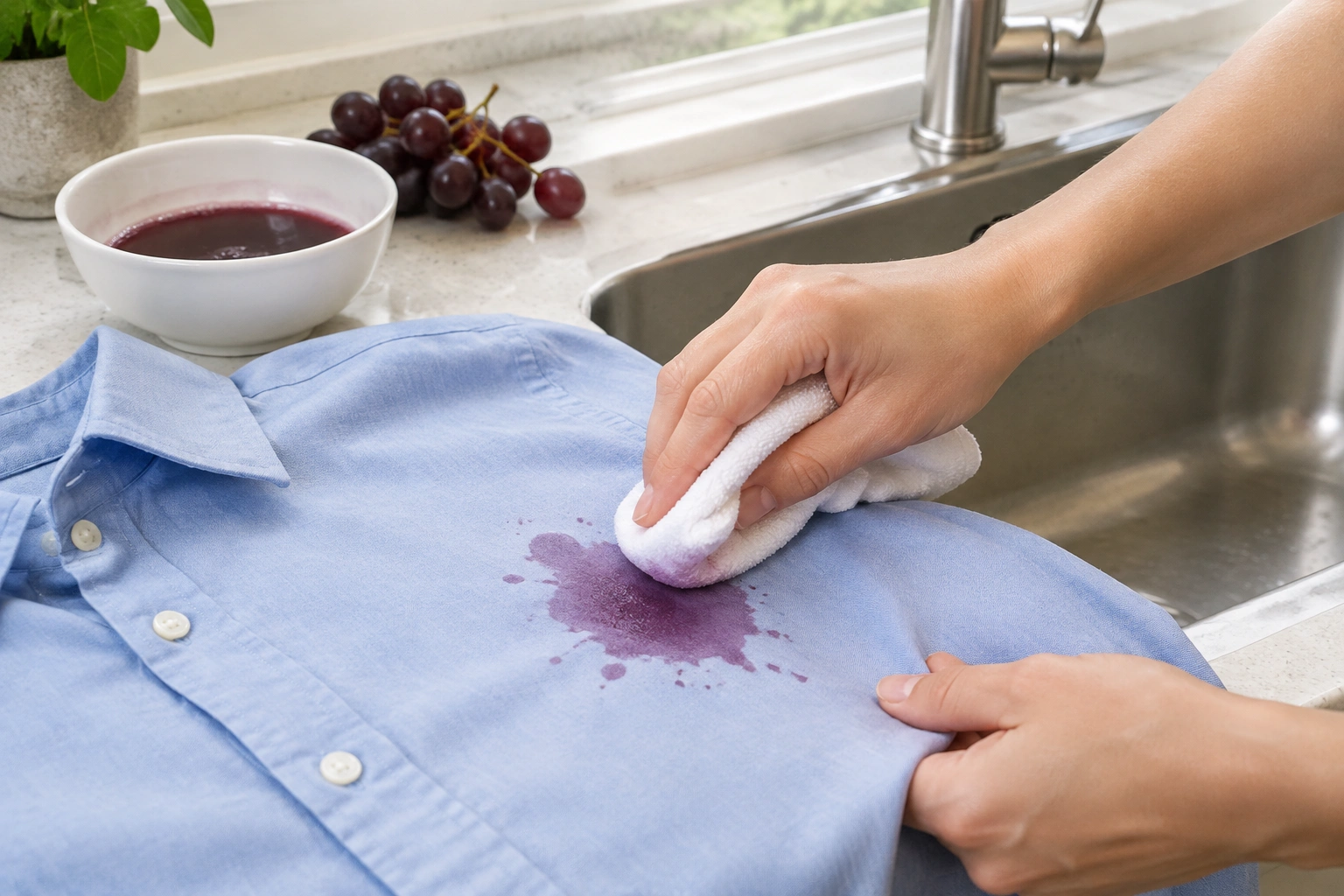
Next, rinse the stained area with cold running water. Cold water is the right choice for the initial rinse because it helps flush out loose pigment before it bonds more tightly with the fabric. If possible, rinse from the back side of the fabric so the water pushes the stain out instead of driving it further in.
If you are away from home, even a quick rinse in a sink, restroom, or bottle of cold water is better than waiting. A small amount of immediate dilution can make the later wash much easier.
What not to do in the first few minutes
- Do not rub hard.
- Do not use hot water first.
- Do not put the item in the dryer.
- Do not assume the stain is gone just because it looks lighter when wet.
Heat is the big mistake here. Once a stain has been dried with heat, the pigment can become much harder to remove.
Choose the Right Path: Fresh vs. Dried, Washable vs. Delicate, White vs. Colored
Before picking a method, make these quick decisions:
- Fresh stain + washable fabric: rinse with cold water, then pre-treat and wash.
- Dried or heat-set stain + washable fabric: re-wet, pre-treat, and expect to repeat treatment if needed.
- White clothing: you may have more options, but only use bleach or stronger treatments if the care label allows it.
- Colored clothing: use color-safe products first and test for colorfastness on a hidden area.
- Dry-clean-only, wool, silk, embellished, or very delicate fabric: stop and follow the care label or use a professional cleaner.
This matters because grape juice is a pigment stain, not just a greasy mark. Some products are good at lifting color, while others are too harsh for certain fabrics. A cotton T-shirt can tolerate treatment that would be risky on wool or silk.
If you are unsure whether a garment is colorfast, test the cleaner on a hidden seam first. That is especially important with vinegar, bleach, or any strong stain remover.
How to Treat Fresh Grape Juice Stains Step by Step
For a washable garment, this is the most practical home method.
1) Blot and rinse
Blot up as much juice as possible, then rinse the back of the stain with cold water. Keep the water flowing long enough to flush out loose pigment, but do not stretch or scrub the fabric.
2) Apply a pre-treatment
Use liquid laundry detergent or a stain remover made for clothing. Apply enough to cover the stain, then gently work it in with your fingers or the tip of the bottle, following the product directions.
3) Let it sit
Give the product time to work before washing. The exact wait time depends on the product label, so follow that rather than guessing. If the stain is still visible after the first treatment, repeat the pre-treatment before laundering.
4) Wash normally, but check the result before drying
Wash the garment according to its care label. Use cold water for the initial rinse, and only use warm water later if the care label and stain-removal product directions allow it.
After washing, inspect the stain while the garment is still damp. If any trace remains, treat it again. Do not use the dryer yet.
How to Treat Dried or Set-In Grape Juice Stains
A dried stain usually needs more patience, not a different category of chemistry.
First, re-wet the stained area with cold water. Then apply detergent or a stain remover and allow more contact time than you would for a fresh spill. For older stains, a soak can help loosen pigment that has already clung to the fibers.
If the garment has gone through the dryer, the stain is harder to remove because heat can set the pigment into the fabric. That does not mean it is impossible. Re-wetting, pre-treating, soaking if the fabric allows it, and repeating the process may still improve or remove the stain.
Tougher stains may respond to soaking and repeat treatment when used as directed. The first pass may lighten the mark, but a second round often does more than scrubbing harder.
If the garment has already been washed but not dried, treat it again before any heat exposure. That is often the best-case scenario for a “still visible after washing” stain, because the fibers are already clean enough to accept another round of treatment.
Best Cleaning Options: Dish Soap, Vinegar, Baking Soda, Stain Remover, and Oxygen Bleach
Not every household remedy is equally useful here. The safest choice is usually the one that matches the fabric and does not create a new problem.
Liquid laundry detergent
This is the most straightforward option for washable clothing and is usually the best first choice after a cold-water rinse. It is designed for fabric and is often enough on its own for a fresh stain when used promptly.
Commercial stain remover
A stain remover can be the better choice if the stain is older or more visible. Follow the label exactly. Some are meant to be rubbed in gently, while others are for soaking or laundering only.
Oxygen bleach
Oxygen bleach is often useful for fruit stains on washable fabrics, especially when you need a stronger lift than detergent alone can provide. It is generally the more fabric-friendly bleach option compared with chlorine bleach, but it still needs to be used according to the package instructions.
White vinegar
Vinegar is commonly suggested online, but it is not the first choice I would reach for on grape juice. It may help in some cases, but it is less reliable than detergent or a purpose-made stain remover, and it should be tested first on color-sensitive items.
Baking soda
Baking soda is another popular home remedy, but it is usually better as a mild helper than as a primary grape-juice stain remover. If you use it, treat it as a low-risk option rather than a guaranteed fix.
Dish soap
Dish soap can sometimes help loosen a fresh stain, especially if you are away from laundry supplies. Still, it is not a stronger option than detergent, and it is usually best used only as a temporary substitute when laundry products are not available.
White Clothes vs. Colored Clothes: What Changes?
White clothes give you more room to use stronger treatments, but only if the fabric is bleach-safe.
The simplest practical rule is this: whites may tolerate stronger treatment, but colored clothing needs a color-safe approach unless the label says otherwise.
For colored garments, the main concern is not just stain removal but also color loss. A cleaner that removes the grape stain can also fade the dye if the fabric is not colorfast. That is why a hidden-area test is worth the extra minute.
If you are dealing with a white school blouse, a white undershirt, or white cotton socks, oxygen bleach or a bleach-safe pre-soak may be appropriate. On a colored shirt, I would stay with detergent, a color-safe stain remover, or oxygen bleach only if the label and product instructions support it.
For more laundry-specific stain guidance on white garments, see how to remove stains from white clothes.
Fabric-Specific Warnings for Cotton, Synthetics, Wool, and Delicates
Cotton
Cotton is usually the easiest fabric to treat. It tolerates rinsing, detergent pre-treatment, and many soak-based methods better than delicate fibers. The main risk is heat drying before the stain is fully gone.
Synthetics
Polyester and similar synthetics often release stains fairly well, but they can also hold onto pigment if the stain sits too long. Use the same basic approach: rinse, pre-treat, wash, and check before drying.
Wool and silk
These need caution. Avoid aggressive scrubbing and avoid bleach unless the care label specifically allows it. A gentle hand treatment and a fabric-safe cleaner are safer than trying to force the stain out. If the item is valuable, dry cleaning may be the better choice.
Delicate or embellished fabrics
Be especially careful with sequins, embroidery, lace, or bonded trims. Liquid can spread into decorative areas, and rubbing can damage the finish. In these cases, a spot test and a minimal-touch approach are better than a full soak.
The care label should have the final say. If it says “dry clean only,” do not assume a home method is safe just because the stain is small.
How to Wash the Garment After Pre-Treating
Once the stain has been treated, wash the garment according to the care label.
Use the normal laundry cycle for the fabric unless the label calls for something gentler. For most washable clothing, the choice is less about a special cycle and more about avoiding heat before the stain is gone. If the item is delicate, hand washing may be safer than a machine cycle.
The most important rule is this: inspect the garment before drying. Air-dry it first if there is any doubt. If the stain remains, another round of treatment is still possible. If you put it in the dryer too soon, you may lock in the pigment and make later removal much harder.
What Not to Do: Heat, Dryer Use, Chlorine Bleach, and Unsafe Mixing
A few common mistakes cause most stain-removal failures.
- Do not dry the garment until the stain is gone.
- Do not use hot water first on a fresh stain.
- Do not scrub hard enough to distort the fabric.
- Do not mix bleach with vinegar, ammonia, or other cleaners.
- Do not use chlorine bleach on fabrics that are not labeled bleach-safe.
- Do not assume a strong cleaner is safe just because the garment is white.
The biggest risk is heat. Once a stain has been dried with heat, it becomes much harder to remove, even though repeat treatment may still help. The second biggest risk is using the wrong bleach on the wrong fabric. Chlorine bleach can be useful on bleach-safe whites, but it is not a universal stain solution.
If the Stain Is Still Visible After Washing
If the stain is still there after one wash, do not re-dry it and hope for the best.
Treat it again while the garment is still damp or newly re-wet the area. A second pre-treatment or a soak often works better than increasing scrub pressure. Repeat treatment is often worth trying before giving up, especially on washable fabrics.
If the stain has faded but not disappeared, that is still progress. A second round can remove the last trace. If the stain barely changed, switch methods rather than repeating the exact same one forever.
When to Replace or Consult a Professional
Stop home treatment and consider professional cleaning when:
- the garment is dry-clean-only,
- the fabric is wool, silk, or another delicate material,
- the item has embellishments, trims, or construction that could be damaged by soaking,
- the stain has already been heat-dried and home treatment is not improving it,
- or the care label limits the products you can safely use.
If you have already tried one careful home treatment on a washable item and the stain is still obvious, a second attempt may be reasonable. But if the fabric is delicate, the stain is large, or the label says dry clean only, it is better to stop than to risk permanent damage.
For a valuable garment, formalwear, or anything you would be upset to lose, a cleaner can be the safer choice from the start.
FAQs
Should I use cold water or hot water?
Use cold water first. It helps dilute the stain without risking heat-setting. Warm water is only for later washing if the care label and stain-removal product allow it.
Will vinegar, baking soda, or dish soap work?
Sometimes, but they are not the most reliable first choices. Liquid laundry detergent, a stain remover, or oxygen bleach is usually a better starting point for grape juice on washable clothing.
Can I use bleach on grape juice stains?
Only on bleach-safe whites, and only if the product instructions and care label allow it. Use chlorine bleach cautiously, and avoid it on fabrics that are not labeled for it.
What if the stain has already been washed?
If it was washed but not dried, treat it again right away. If it was washed and dried, it may still come out, but expect to repeat the process and use more patience.
Can a dried grape juice stain still come out?
Often, yes. Dried stains usually need re-wetting, pre-treatment, and sometimes soaking. The earlier you address it, the better the odds.
Is oxygen bleach better than chlorine bleach?
For many washable fabrics, oxygen bleach is the safer choice because it is generally less harsh on color and fabric. Chlorine bleach is stronger, but it carries more risk and should be limited to bleach-safe whites.
How do I know if the fabric is colorfast?
Test the cleaner on a hidden area first. If the color transfers, fades, or changes, stop and use a gentler method.
Should I dry the clothes in the sun?
Only after you have removed any excess stain-remover solution, especially if the treated area will be exposed to direct sunlight.
For broader laundry stain guidance beyond grape juice, you may also find how to remove stains from clothes useful.