
How to Fix a Stuck Suitcase Zipper Without Damaging Your Luggage

A stuck suitcase zipper is one of those problems that feels bigger than it is—especially when you need the bag open now. The good news: most jams come from a small handful of causes, and the safest fixes are usually simple.
Quick decision tree:
– Fabric or lining caught? Free the snag first.
– Zipper feels dry, gritty, or sticky? Try a small amount of lubricant.
– Teeth look uneven or won’t mesh? Realign the teeth and check the track.
– Slider looks bent, loose, or skips teeth? The slider may need gentle adjustment or replacement.
– Pull tab is broken or missing? Use a temporary grip to open the bag, then plan a proper repair.
The key is to diagnose before you pull harder. A zipper caught on fabric needs a different approach than one with dry, gritty teeth or a slider that has gone out of shape. If you treat every jam the same way, you can turn a minor annoyance into a broken slider, bent teeth, or torn lining.

This guide walks through the least risky repair order first, so you can free the zipper, avoid making the damage worse, and decide whether the suitcase is worth a home fix or a repair shop visit.
What a Stuck Suitcase Zipper Usually Means
When a suitcase zipper stops moving, it usually falls into one of five buckets:
- Fabric or lining is caught in the slider
- Dirt, grit, or dried residue is increasing friction
- The zipper teeth are misaligned
- The slider is bent or no longer gripping the teeth properly
- The pull tab is broken, missing, or too damaged to use normally
That distinction matters because the fix changes. If fabric is trapped, lubrication won’t solve it. If the zipper is just rough, forcing it is the fastest way to damage it. And if the slider is worn, you may be able to coax it temporarily, but the problem will likely return.
What You’ll Need Before You Start
You do not need a toolkit. Keep it simple.
Minimum first-aid tools
- A flashlight or phone light
- A clean cloth or tissue
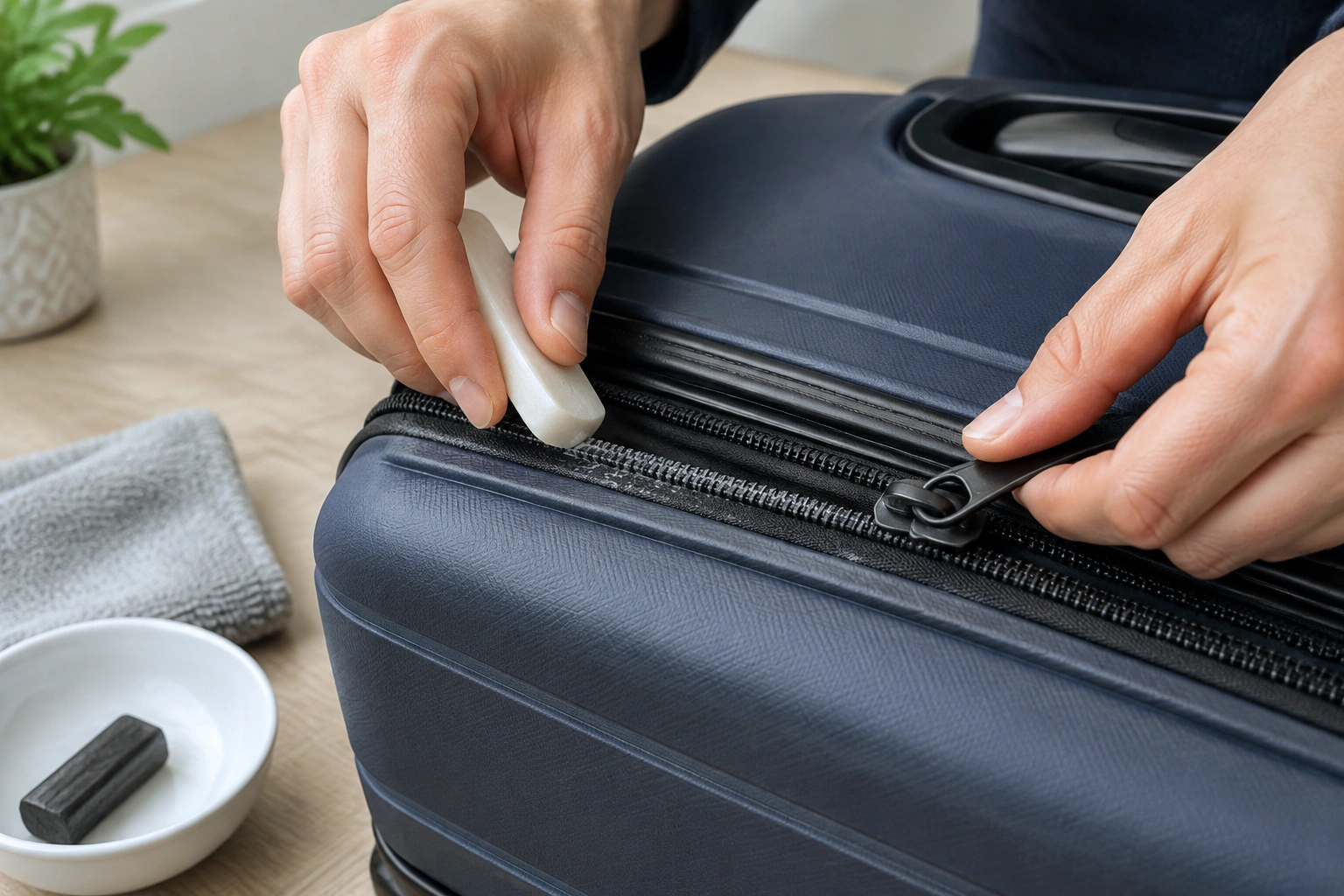
- One safe lubricant: graphite pencil, bar soap, candle wax, or lip balm
Optional tools
- A cotton swab
- Needle-nose pliers
- A seam ripper for fabric snags
A flashlight helps more than people expect. Zipper jams often happen at corners, under flaps, or where the lining folds back on itself. Seeing the exact pinch point saves time and prevents blind pulling.
If you have a hard-shell suitcase, expect less access around the zipper channel, so inspection and alignment may take a little more patience. Soft-sided luggage usually gives you more room to manipulate the fabric and slider.
Fastest Safe Fix: Try the Least Risky Steps First
Use this order:
- Stop pulling hard
- Inspect the jam
- Free any visible fabric or thread
- Apply a small amount of lubricant if the zipper feels dry or gritty
- Gently work the slider back and forth
- Check for misaligned teeth or a bent slider
- Stop if the zipper skips, binds again, or feels like it is ripping
That sequence matters because each step builds on the last. Lubricant helps friction. Alignment helps mechanical jams. Force does neither.
DELSEY’s suitcase repair guidance says not to force a stuck zipper because it can damage the zipper or break the slider. Their advice also includes using a small amount of household lubricant such as lip balm, bar soap, candle wax, or a graphite pencil, then gently moving the zipper back and forth. You can read that guidance on DELSEY’s suitcase zipper repair page.
Step 1: Inspect the Zipper for Fabric, Debris, or Misalignment
Look closely at the point where the zipper stopped. You are trying to answer one question: what is physically blocking movement?
Check for:
- A shirt hem, lining, or strap caught in the slider
- Loose thread wrapped around the teeth
- Dirt, sand, or crumbs packed into the track
- Teeth that are no longer meeting evenly
- A slider that sits crooked or loose on the track
If the zipper is stuck on fabric, you will usually see the material pinched inside the slider opening. If the teeth are misaligned, one side may be riding higher than the other. If the slider is the problem, the zipper may move a little and then immediately slip or separate behind it.
Step 2: Free a Zipper Stuck on Fabric or Lining
If fabric is trapped, do not yank the pull tab. That can shred the lining or tear the zipper tape.
Instead:
- Hold the suitcase steady so the zipper area is not under tension.
- Use your flashlight to find exactly where the fabric is pinched.
- Gently back the slider up a few millimeters if it will move.
- Use your fingers to flatten and guide the trapped material away from the teeth.
- If the fabric is deeply caught, use a seam ripper carefully to release only the thread or edge that is trapped.
A useful trick from luggage repair advice is to grip the zipper body itself—not just the pull tab—and gently push or ease it open to release trapped material. That works because the slider body gives you a little more control than the dangling pull.
If you’re dealing with a packed suitcase before a flight, work slowly. The goal is to create slack, not to “win” against the zipper. On a corner snag, even a few millimeters of movement can be enough to free the lining.
If the bag must be opened immediately and only partial opening is possible, stop once you have enough access to retrieve what you need. Do not keep forcing the zipper wider if the slider is binding or the teeth are starting to separate.
Step 3: Use a Lubricant to Loosen a Stiff or Rough Zipper
If the zipper is not snagged on fabric but feels gritty or stiff, a small amount of lubricant can help.
Soap, wax, or graphite: what to use
Here is the practical comparison:
| Lubricant | Best for | Trade-off |
|---|---|---|
| Bar soap | Easy, quick fixes; common household use | Can leave residue if overapplied |
| Candle wax | Smooth movement on dry zipper teeth | Can smear if applied too heavily |
| Graphite pencil | Cleaner dry option for many zippers | Can be messier to apply precisely |
| Lip balm | Emergency fix when nothing else is available | May leave an oily residue on fabric |
A simple rule is to start with the driest option that will do the job. Graphite and dry soap are less likely to leave a noticeable film than oily products. That said, any lubricant should be used sparingly.
How to apply it
- Rub a small amount directly on the zipper teeth near the jam.
- Keep it off the fabric as much as possible.
- Move the slider a short distance back and forth.
- Reapply only if needed.
A good way to think about it: you are not greasing a machine part. You are reducing friction just enough to get the slider moving again.
If you want a second source on the same approach, Capsule Suitcase also suggests bar soap or lip balm for sticky zippers and recommends applying a small amount before moving the zipper gently.
Step 4: Realign the Zipper Teeth or Slider
If lubrication does not help, the problem may be mechanical rather than dry.
A zipper can stick because the teeth are not entering the slider evenly. That can happen after overpacking, rough handling, or repeated stress at the same spot. In that case:
- Open the zipper as far as it will go.
- Inspect both sides of the teeth.
- Use your fingers to nudge any visibly shifted teeth back into line.
- Try moving the slider a short distance again.
- If the slider feels loose or skips, stop and reassess.
If the teeth are misaligned, focus on getting both sides to meet evenly before trying again. On a soft-sided suitcase, you can often smooth the fabric near the zipper channel and work the teeth back into place with your fingers. On a hard-shell suitcase, access is tighter, so check the visible section carefully and use short, controlled movements rather than trying to pry the zipper open.
If the slider is bent, the fix is different. A bent slider may sit crooked, wobble, or fail to grip the teeth even when they are aligned. In that case, gentle pressure with needle-nose pliers may help restore a better bite, but only slightly. Too much pressure can crush the slider and make the problem permanent. If the slider still skips or separates after a very light adjustment, stop and treat it as a worn part rather than a lubrication problem.
Step 5: Handle a Zipper Stuck at a Corner or Curve
Corners are where suitcase zippers fail most often because the zipper tape bends while the bag is under tension.
If the zipper jams at a corner:
- Set the suitcase on a flat surface
- Reduce pressure inside the bag if possible
- Pull from the direction the zipper wants to travel, not at an angle
- Use short, controlled movements instead of one long pull
If the corner is tight on a hard-shell suitcase, you may need to press the shell slightly inward near the zipper path to reduce strain. On a soft-sided bag, you can usually smooth the fabric with your free hand and create a cleaner path.
The mistake to avoid here is pulling diagonally on the slider. That twists the teeth and makes the jam worse.
What to Do If the Zipper Pull Is Broken or Missing
A missing pull tab does not always mean the suitcase is unusable.
If the slider itself is intact, you can sometimes move it with:
- A paperclip
- A small key ring
- Needle-nose pliers, used carefully
The goal is simply to get enough grip to move the slider without crushing it. If you use pliers, hold the slider lightly and avoid squeezing the body of the mechanism. You want control, not deformation.
If the pull tab broke because the slider is already loose or bent, that is a sign the repair may be bigger than a simple handle replacement.
How to Tell If the Problem Is a Broken Tooth or a Worn Slider
This is the point where many people keep trying the same fix and make things worse.
Signs of a broken tooth
- A visible gap in the zipper track
- The slider catches in the same spot every time
- The teeth do not interlock cleanly after passing the damaged area
Signs of a worn slider
- The zipper closes, then opens behind the slider
- The slider feels loose on the track
- You need repeated pressure to get the teeth to “bite”
A broken tooth is often a stop sign for DIY repair. A worn slider may sometimes be replaced, but once the slider stops gripping properly, the zipper usually needs more than lubrication.
Common Mistakes That Make Suitcase Zippers Worse
These are the habits that turn a fixable jam into a repair job:
- Forcing the pull hard
- Pulling at an angle
- Using too much lubricant
- Ignoring trapped fabric or thread
- Trying to zip over a broken tooth
- Squeezing the slider aggressively with pliers
- Using open flame or heat near the zipper
That last one is worth saying plainly: do not use a torch, lighter, or other heat source to “loosen” a stuck zipper. It can damage the suitcase fabric, melt synthetic components, and create a safety hazard.
When DIY Repair Is Enough vs When to Get Professional Help
A home fix is usually reasonable when:
- The zipper is stuck on fabric or thread
- The zipper is dry or dirty
- The teeth are slightly out of line
- The slider is still mostly functional
You should stop and see a luggage repair specialist when:
- The zipper keeps separating after you close it
- A tooth is missing or visibly broken
- The slider is bent, cracked, or too loose to grip
- The zipper jams in the same spot after two careful attempts
- The suitcase is hard-shell and you cannot access the jam without risking damage
If the bag is expensive, heavily used, or needed for travel soon, professional repair is often the better trade-off. Stop trying at home if the zipper repeatedly separates or a broken tooth keeps catching in the same place; that usually means the track or slider is beyond a simple fix.
Practical Examples of Common Stuck-Zipper Scenarios
1) Lining snag before a trip
You pack a carry-on too full, close the lid, and the zipper stops near one corner. In this case, inspect for a caught lining first. If you see fabric in the slider, free it before adding any lubricant.
2) Rough zipper from residue
A checked bag has been handled a lot and the zipper feels gritty. This is the situation where a tiny amount of soap, wax, or graphite often helps. Work it in gradually and wipe away excess afterward.
3) Corner jam on a hard-shell suitcase
The zipper binds at the curve because the shell is under pressure. Here, reduce internal pressure, straighten your pull angle, and move the slider in short increments. If the slider skips teeth, stop and inspect the track.
4) Zipper pull is missing
The pull tab breaks off, but the slider still works. A temporary grip with a paperclip or pliers may get you through the moment, but the missing pull often points to wear elsewhere in the mechanism.
How to Prevent the Zipper from Sticking Again
A little maintenance goes a long way.
- Close luggage without overstuffing it
- Keep loose threads trimmed near the zipper path
- Wipe grit off the teeth after trips
- Use a small amount of dry lubricant occasionally if the zipper starts to feel rough
- Avoid yanking the slider around corners
If you travel often, give your suitcase zipper a quick check before each trip. Catching a tiny snag early is much easier than repairing a jammed slider in a hotel room or airport parking lot.
When to See a Luggage Repair Specialist
If the zipper still will not move after careful inspection, a small amount of lubricant, and gentle realignment, it is time to stop. The same is true if the zipper keeps failing in the same place. At that point, the issue is probably not friction—it is wear, damage, or a slider that no longer fits the track properly.
A specialist can assess whether the zipper can be saved with a slider replacement or whether the track itself is too damaged. That is usually cheaper than replacing a good suitcase just because one closure failed.
If you want to keep your luggage in good condition beyond the zipper, our guide on how to clean a backpack covers the same basic care mindset: remove buildup early, handle materials gently, and avoid turning small problems into permanent damage. For site policies and support, you can also review our disclaimer or contact us.